Overview#
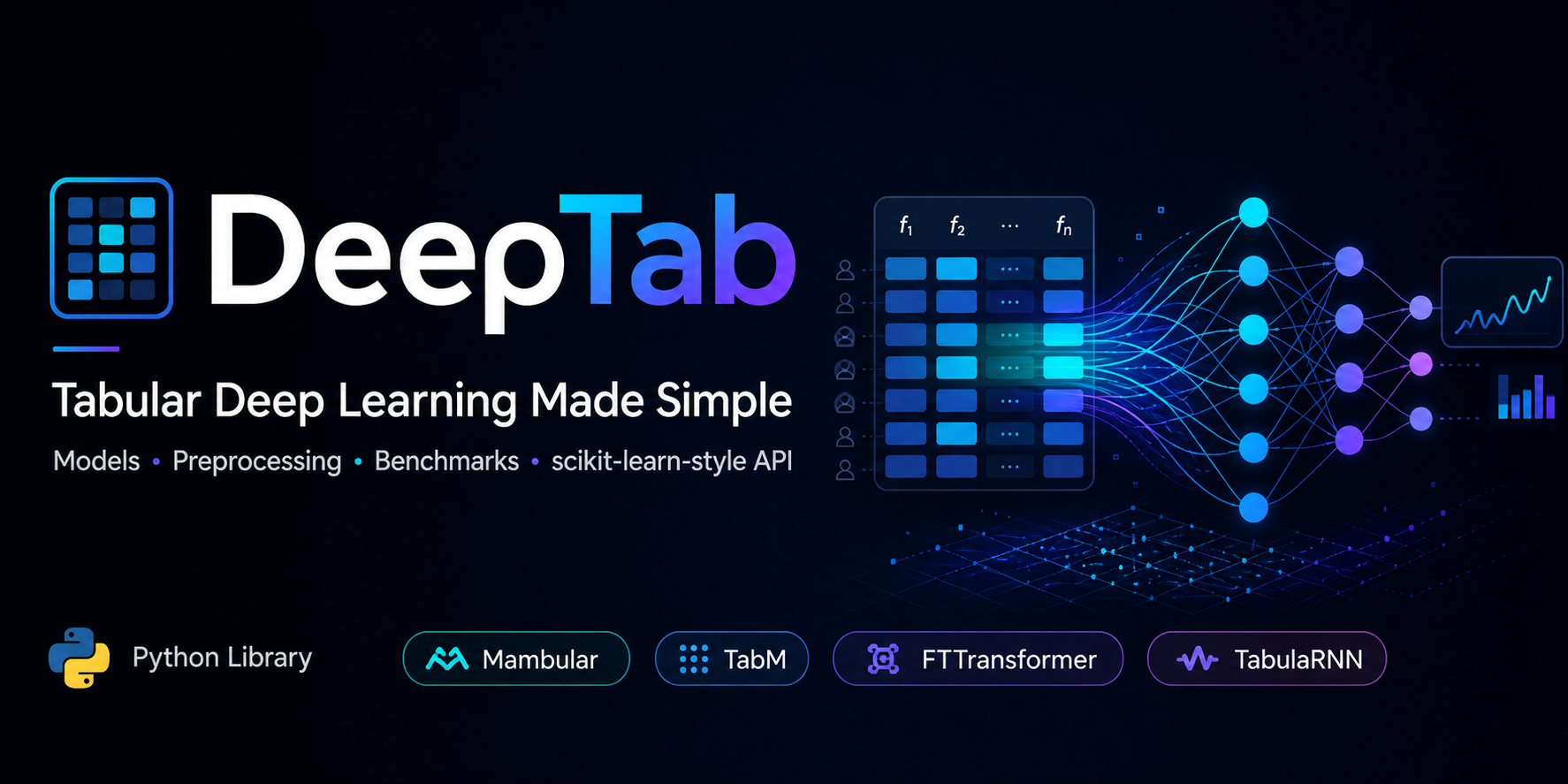
DeepTab is a Python library that brings modern deep learning architectures to tabular data. It wraps PyTorch and Lightning behind a scikit-learn-compatible interface, so you can use state-of-the-art models without changing how you already work with data.
Why DeepTab#
Tabular data is the most common format in applied machine learning, yet most deep learning tooling is designed for images or text. DeepTab fills that gap by:
Providing a consistent
fit/predict/evaluateAPI across all models.Handling categorical encoding, numerical preprocessing, and batching automatically.
Supporting regression, classification, and distributional regression from the same model class.
Integrating with scikit-learn pipelines and hyperparameter search tools.
Available models#
All models support regression, classification, and distributional regression out of the box. Import them as <ModelName>Regressor, <ModelName>Classifier, or <ModelName>LSS.
Model |
Architecture |
Reference |
|---|---|---|
|
Sequential Mamba (SSM) blocks for tabular data |
|
|
Mamba block on a joint input representation |
|
|
Mamba + Transformer hybrid |
|
|
Feature tokeniser + Transformer encoder |
|
|
Transformer with categorical embeddings |
|
|
Row attention + contrastive pre-training |
|
|
Batch ensembling for MLP |
|
|
Retrieval-augmented tabular model |
— |
|
ResNet adapted for tabular data |
— |
|
Multi-layer perceptron baseline |
— |
|
Neural oblivious decision ensembles |
|
|
Neural decision tree forest |
|
|
Recurrent neural network for tabular data |
|
|
Extended NODE variant |
— |
|
Automatic feature interaction via attention |
— |
|
Modern neural classification architecture |
— |
|
Tabular-specific prompting model |
— |
|
Tabular model with graph-based structure |
— |
Next steps#
Installation — install DeepTab and verify the setup.
Key Concepts — understand the API patterns before writing code.
Examples — runnable end-to-end workflows.
API Reference — full parameter documentation.